A dive light needs the right beam and dependable power for its role. Peak lumens alone miss runtime, beam concentration and how output changes as the battery runs down. These ten handheld designs range from compact lights to more substantial units. They are not a complete lighting configuration for overhead or technical diving.
Updated · Manufacturer specifications and published review evidence
How we chose and ordered these picks
General handheld spot lights lead, followed by simpler battery options and larger lights. Published output is identified as a manufacturer claim, not our measurement.
List position is an editorial recommendation, not a review score. The selection uses the documented features and limitations below. We have not personally tested this equipment. Verified publisher scores, where available, are shown separately and link to their evidence. Our catalogue is still being researched; inclusion does not mean a product has a completed scored review.
The shortlist at a glance
Choose a model to jump to its details. Compare the exact configuration before ordering.
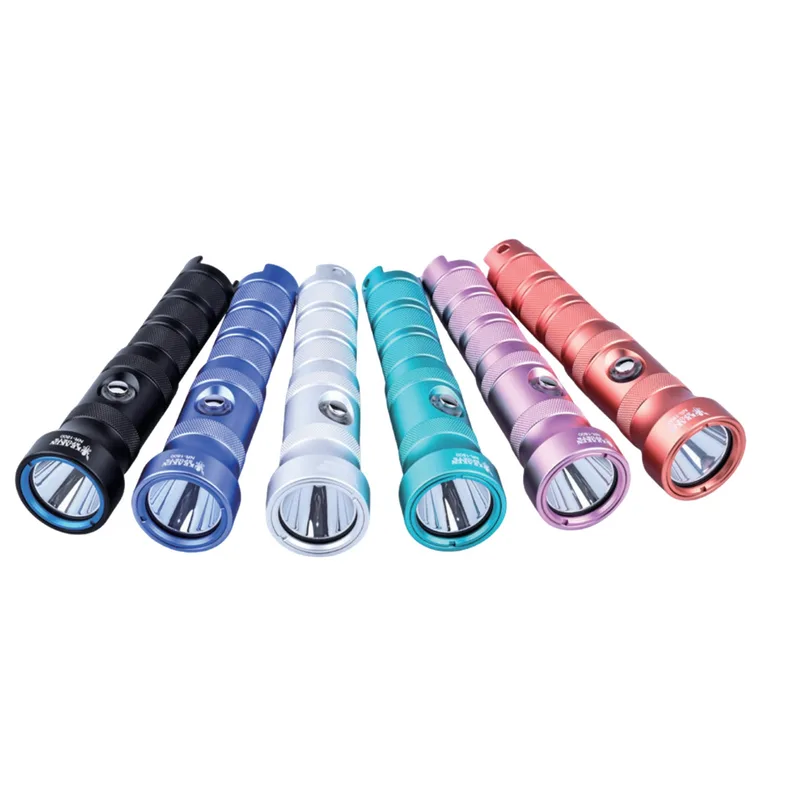
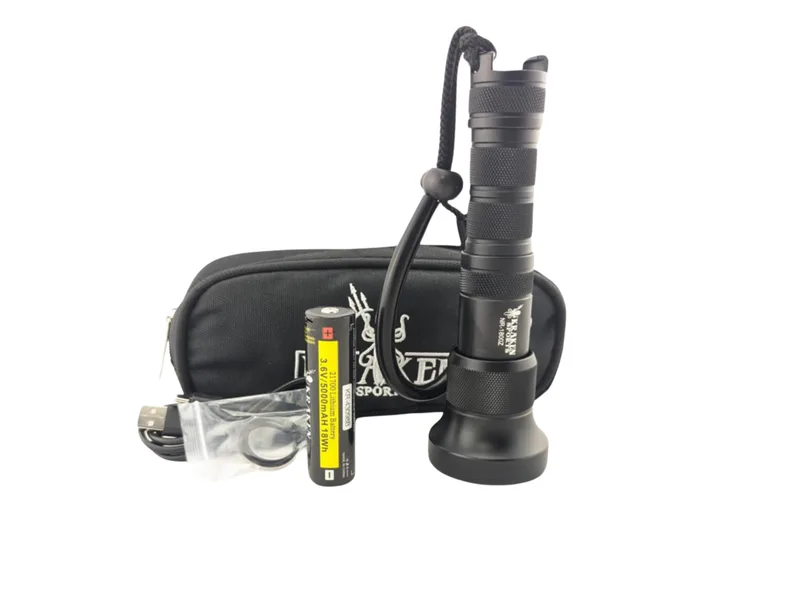
The current NR-2000 is a compact 2000-lumen handheld torch with a 6° spot beam and a button-mounted battery indicator. Kraken lists 70 minutes at full power and a 230 g land weight. Full, half and quarter brightness settings let you reduce the output for nearby subjects.
Output
2000 lumens
Beam
6°
Rated full-power runtime
70 minutes
Dimensions
42 × 153 mm
Weight
230 g land; 65 g underwater
What to check
Kraken has used NR-2000 for two different products. The present 42 × 153 mm light succeeds NR-1800; the larger discontinued NR-2000 preceded NR-2500. DIVEIN’s older review lists different dimensions and weight, so its observations cannot be assumed to describe the current product or its battery compatibility.
No verified independent overall score yet. Compare the specifications and limitations above.
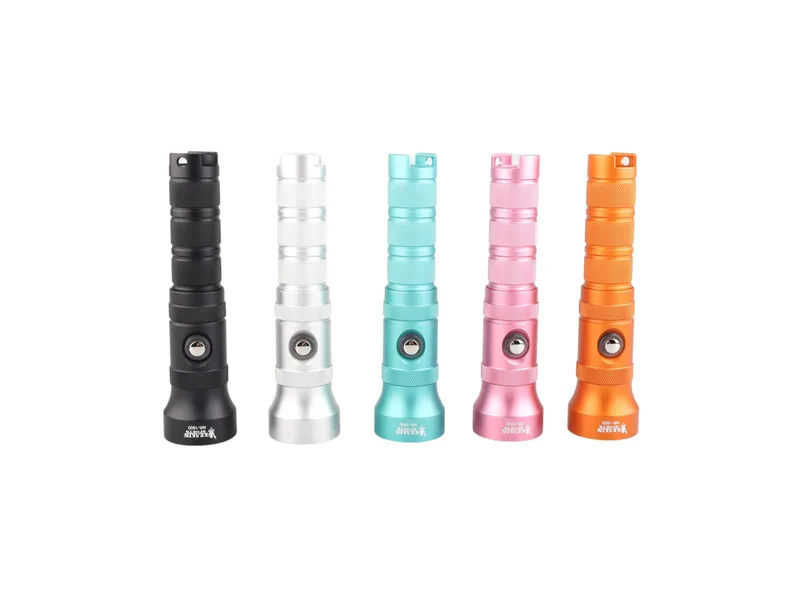
The NR-1800 is an earlier-generation handheld light with a rechargeable 21700 cell and USB-C charging at the battery. Kraken’s current specification lists 1800 lumens, a 6° beam and 90 minutes at full power. A push button provides brightness selection and a battery-status indicator.
Output
1800 lumens
Beam
6° on current manufacturer page; older listings differ
Battery
21700; USB-C charging
Rated full-power runtime
90 minutes
Weight
249 g land; 70 g underwater
What to check
Some retailer descriptions still quote a 15° beam. Our specification follows the current manufacturer listing, but confirm the actual version if buying older stock. The 249 g land weight and 70 g underwater weight mean that it is not neutrally buoyant, despite loose wording elsewhere in the product description.
No verified independent overall score yet. Compare the specifications and limitations above.
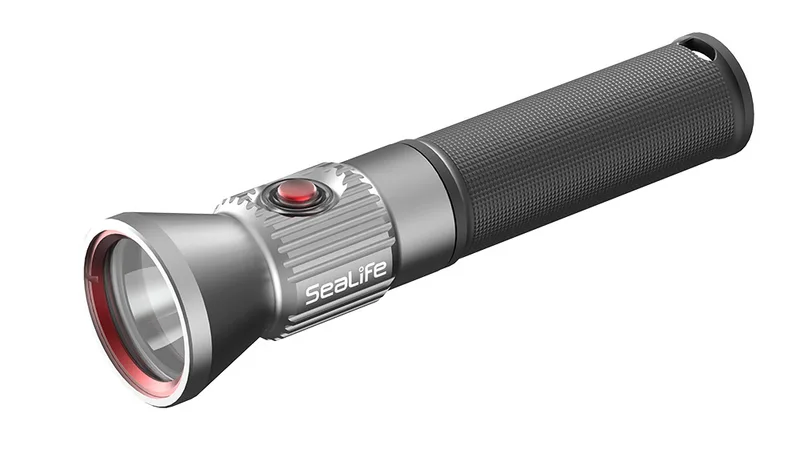
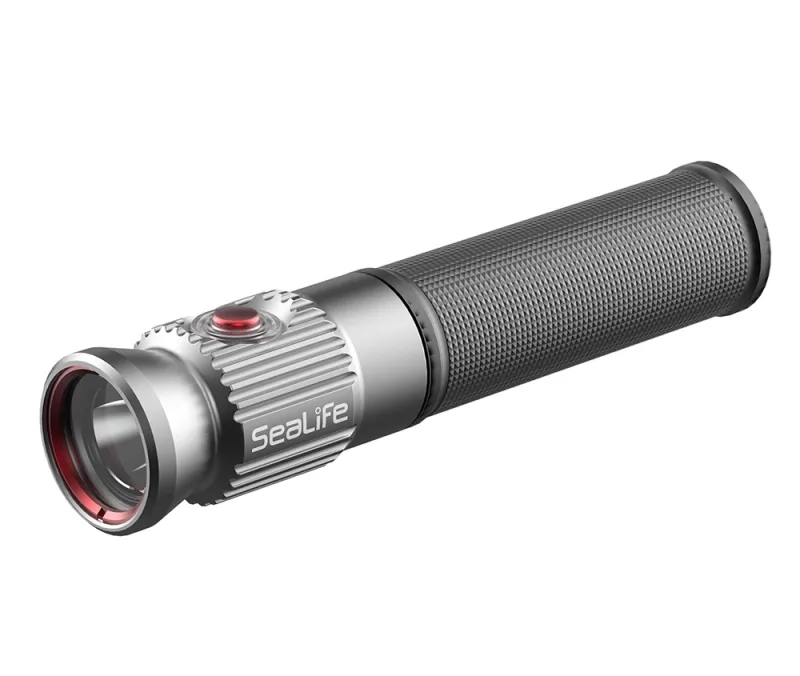
The Mini 1600 increases SeaLife’s compact torch output to 1600 lumens and narrows the underwater beam to 4.5°. It retains three brightness settings, flash and SOS modes, plus an optional instant-on configuration. The concentrated beam favours a small area of interest over broad camera coverage.
Output
1600 lumens
Underwater beam
4.5°
Brightness levels
100%, 50%, 25%
Signalling
Flash and SOS
Camera mounting
Optional YS adapter SL98104
What to check
Confirm whether your chosen package includes the battery and charger. ScubaLab’s first look covers both the 1200 and 1600 and comments favourably on their handling, but supplies no overall numeric grades. Its impressions do not prove that the 1600 is a better fit for every diver.
No verified independent overall score yet. Compare the specifications and limitations above.
The Mini 1200 is a handheld spot light with 1200 lumens and a 6° underwater beam. Three brightness levels make it easier to reduce output for close work, and separate flash and SOS functions provide signalling options. An optional YS adapter allows mounting beyond the supplied lanyard arrangement.
Output
1200 lumens
Underwater beam
6°
Brightness levels
100%, 50%, 25%
Signalling
Flash and SOS
Camera mounting
Optional YS adapter SL98104
What to check
The 6° figure describes the beam underwater, which matters when comparing it with lights quoted in air. Check whether the listing is the bare light or the battery-and-charger kit. ScubaLab’s first look praises the grip and compact format but is not a long-term test or a scored comparison.
No verified independent overall score yet. Compare the specifications and limitations above.
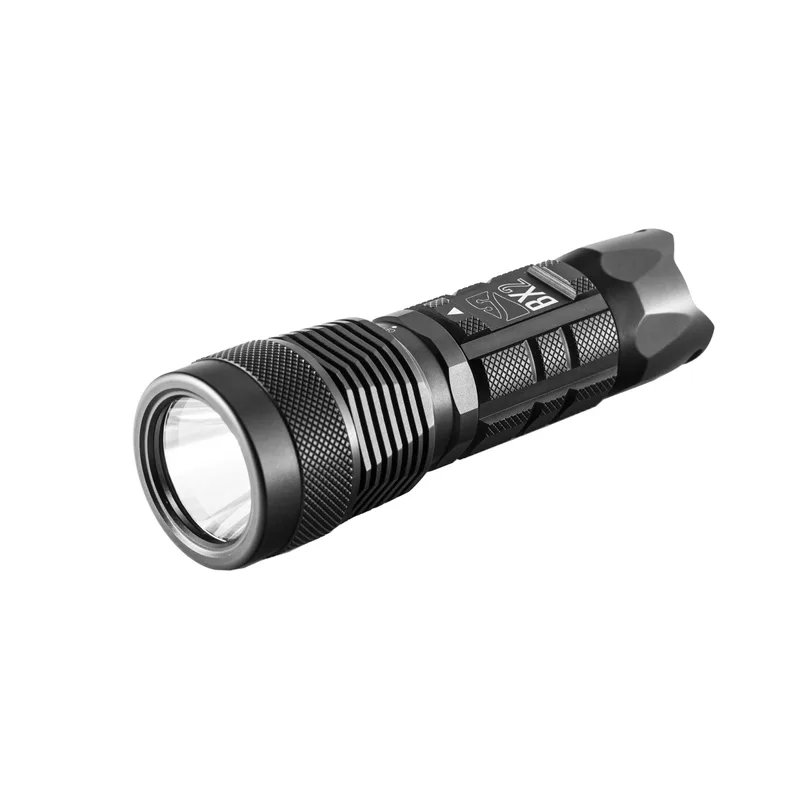
The BX2 is a twist-on handheld torch with a focused centre beam and surrounding spill. Its knurled body gives you a substantial gripping surface, while compatibility with Dive Rite’s QRM system provides a route to mounting it on a hand strap. The current package includes a rechargeable 18650 cell, cable, lanyard and case.
LED
CREE XP-L high intensity
Control
Twist activation
Battery
3500 mAh rechargeable 18650; micro-USB charging
Output behaviour
Over one hour at peak, then gradual reduction (manufacturer)
Mounting
QRM compatible
What to check
Dive Rite describes more than an hour at peak output followed by a gradual reduction. That is different from several hours at unchanged brightness. Check the battery supplied with the actual package: older owner accounts describe different charging arrangements. Try the twist control with your usual gloves before deciding how to stow it.
No verified independent overall score yet. Compare the specifications and limitations above.
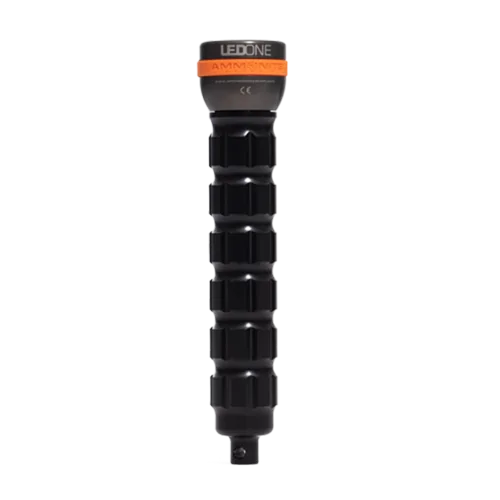
The LED ONE is a 400-lumen backup torch built around three AA cells and a narrow 6° beam. Ammonite lists up to seven hours of constant output. The Delrin body and aluminium head use twist activation, keeping the controls simple and the battery choice familiar.
Output
400 lumens
Beam
6°
Battery
Three AA cells
Rated runtime
Up to seven hours
Depth rating
200 m
What to check
The narrow spot is useful for directed illumination but covers little of a camera’s view. Its output is also modest beside the Stingray MKII. The manufacturer accepts AA batteries or rechargeable cells; check the approved cell specification before buying replacements rather than assuming every AA-shaped lithium cell is suitable.
No verified independent overall score yet. Compare the specifications and limitations above.
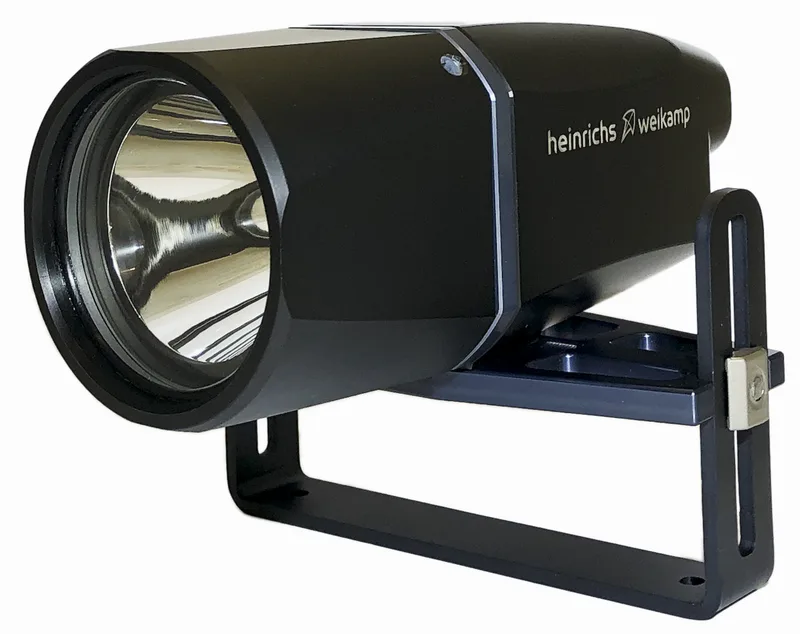
The hw Backup is a small twist-operated torch using one replaceable 18650 cell. Its 8° beam and 4000 K LED favour a focused view over broad scene lighting. The manufacturer lists at least 350 lumens of measured output, separating that figure from the LED’s higher nominal chip output.
Beam
8°
Measured output claim
At least 350 lm
Colour temperature
4000 K
Battery
One 18650; 3500 mAh cell supplied
Dimensions and weight
30 × 130 mm; 200 g
Stated runtime
2 h constant, then 6 h reduced
Manufacturer depth rating
300 m
What to check
The supplied 3500 mAh cell is listed separately from the optional charger. Stated runtime is two hours at constant brightness followed by six hours at reduced output; that tail is not six more hours at full power. Unterwasserwelt’s reviewer liked handling and communication in poor visibility but found cosmetic wear appeared quickly. Its text gives conflicting weights, so the current manufacturer’s 200 g figure is used.
No verified independent overall score yet. Compare the specifications and limitations above.
The NR-1800Z changes beam width by twisting the head, from a 10° spot to a 45° spread. Its 1800-lumen output and stated 90-minute full-power runtime sit in a 290 g handheld package. The battery indicator is integrated into the push button.
Output
1800 lumens
Adjustable beam
10–45°
Rated full-power runtime
90 minutes
Dimensions
55.5 × 174.3 mm
Weight
290 g land; 140 g underwater
What to check
The wider setting is still narrower than a dedicated video flood. Bluewater Photo’s retailer guide notes unevenness at the tightest zoom setting, which is worth checking before buying for camera work. That guide also contains colour-temperature and red-mode claims inconsistent with the current manufacturer page; those claims are not adopted here.
No verified independent overall score yet. Compare the specifications and limitations above.
The hw40 is a self-contained primary torch with a narrow 5° beam, four power settings and an adjustable Goodman handle. Its 50.3 Wh battery charges through USB-C Power Delivery after opening the housing. The manufacturer lists 75,000 lux at one metre in air; this is beam intensity, not 75,000 lumens of total output.
Beam
5°
Power settings
5 / 10 / 20 / 40 W
Battery
50.3 Wh, four 18650 cells
Stated runtime
70 min at 40 W; 150 min at 20 W
Charging
USB-C PD input; up to 45 W
Ready-to-use weight
666 g including Goodman handle
Manufacturer depth rating
300 m
What to check
At the highest 40 W setting, the stated runtime is about 70 minutes, compared with 150 minutes at 20 W. Plan around the selected setting and reserve, not the longest low-power figure. Charging requires clean, dry handling of the opened light, and the USB-C port accepts power but cannot charge other devices. Forum discussion raises handling questions without establishing failure rates.
No verified independent overall score yet. Compare the specifications and limitations above.
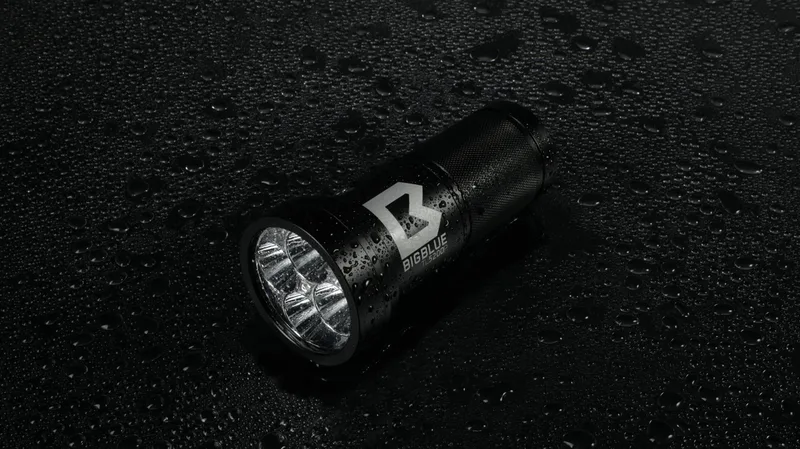
The TL5200P is a self-contained technical torch supplied with a battery, charger, lantern handle and soft Goodman glove. Bigblue’s current specification gives a 7° beam and four output levels from 520 to 5200 lumens. The included handles let buyers assess two ways of carrying the light without adding a battery canister.
Model
TL5200P
Current beam specification
7°
Output levels
520 / 1300 / 2600 / 5200 lm
Battery
BATCELL18650x4 rechargeable pack
Stated runtime
2 h high; 20 h low
Operating weight
596 g with battery
Manufacturer depth rating
150 m
What to check
Current primary data lists a BATCELL18650x4 pack and two hours at maximum output. Retail listings disagree on beam angle and one names a different battery format; confirm the supplied generation rather than mixing their tables. The manufacturer’s 596 g operating weight is distinct from the three-pound package weight. Longest runtime means the lowest setting.
No verified independent overall score yet. Compare the specifications and limitations above.
Product research checked 2026-10-03. Specifications can change; confirm the exact model and package.
Before you buy
Compare runtime at the setting you plan to use.
Check charging arrangements and spare-battery availability.
Choose beam width for the task rather than treating the highest lumen number as best.
Take two or three suitable models from this list into a comparison, then remove any that fail your fit or compatibility checks. A lower position here can still be the better purchase for your setup. Check the product page for source dates and unresolved details before placing an order.
Is the brightest light always easiest to see with?
No. Beam concentration, water conditions and backscatter matter. A broad high-output beam and a narrow spot serve different purposes.